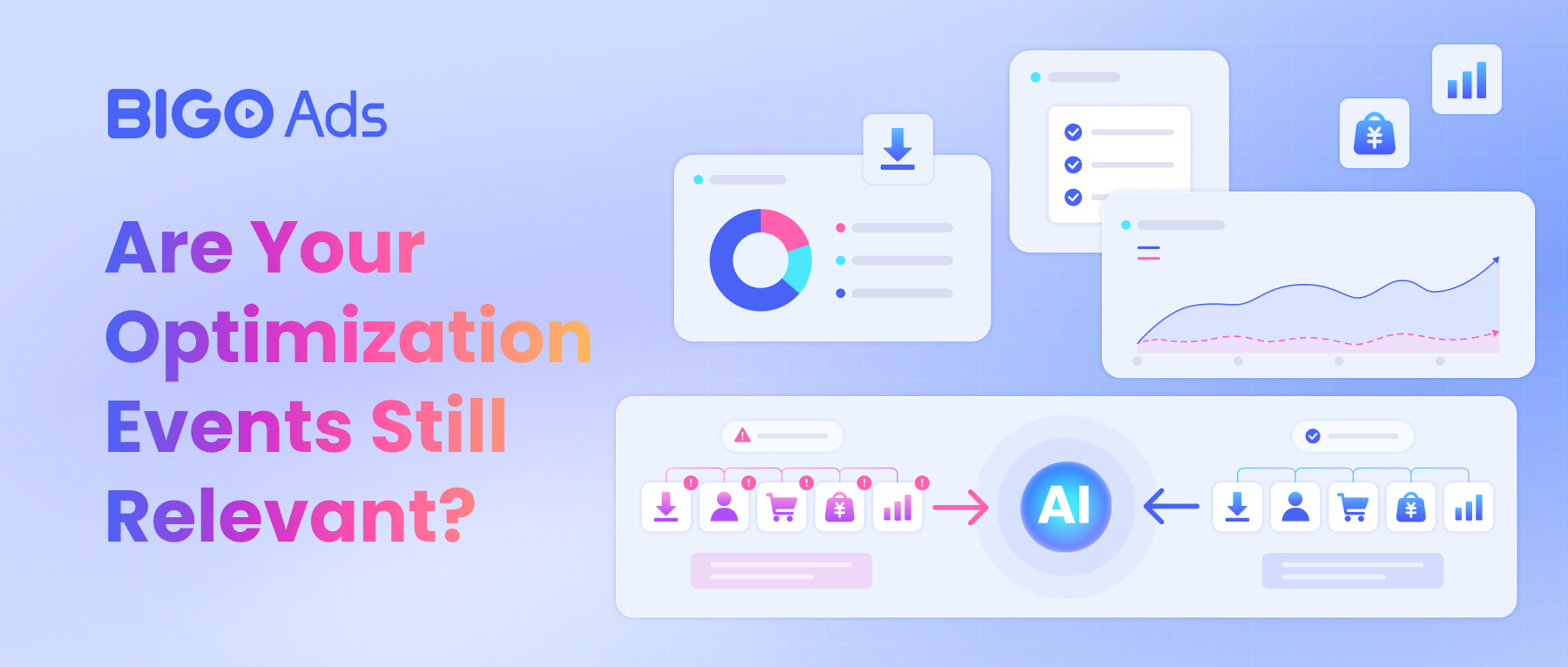
CPI is stable. Registration cost is down. The dashboard looks healthy.
But the team is still asking the same question:
Why are retention and revenue barely moving?
This kind of gap — strong front-end numbers, weak downstream results — is often a sign that the optimization event needs another look.
During a mid-year review, many teams start with the usual levers: increase budget, refresh creatives, adjust bids, test new markets.
All of that matters. But there is one question that is easier to miss:
Is the event you set at the beginning of the year still accurate today?
A lot can change in six months. The product may have been updated. Landing pages may have changed. Creative angles may have gone through several rounds of testing. User journeys may be shorter. Promotional mechanics may be different.
If your campaign is still learning from the same event, the system may not be “underperforming.” It may be doing exactly what you asked — learning from a signal that no longer reflects real user value.
The problem is not always volume.
It is not always cost.
Sometimes, the signal itself has gone off track.
01 Install: You Have the Volume, But Are They the Right Users?
Install is a useful event for early-stage campaigns. It is simple, direct, and helps accounts collect data quickly.
But by mid-year, if your product has moved into a more stable growth phase, optimizing only for installs can lead to a familiar situation:
CPI looks good. New users are coming in. But D1 and D7 retention are flat. Payment rate is unstable. Ad revenue is not growing at the same pace.
At that point, the better question is not “how many more installs can we buy?”
It is:
What happens after the install?
Do users open the app again?
Do they complete onboarding?
Do they finish the first level?
Do they watch a rewarded video?
Do they enter the payment flow?
Install is not a bad event. It may simply be too early in the journey to guide your next stage of growth.
Try this instead:
If post-install quality is weakening, consider moving the optimization event deeper — for example, onboarding completion, second app open, first session completion, or first rewarded video view.

02 Registration: When the Barrier Gets Lower, the Signal Gets Noisier
Registration looks like a stronger signal than install. A user is willing to sign up, so the intent should be higher.
But registration can become noisy very quickly.
Maybe the sign-up flow has been shortened. Maybe incentives have been added. Maybe one-tap login has made the process much easier.
Registration rate goes up. CPA goes down. The report looks better.
But if activation, add-to-cart, purchase, or subscription does not improve after registration, the event may simply have become easier to complete. It does not necessarily mean those users are more valuable.
A useful mid-year question is:
After registration, do users actually move forward?
If the answer is no, it may be time to shift the optimization focus one step deeper.
Try this instead:
When registration becomes too easy, test events such as first use of a core feature, key page view, first session completion, or first level completion. These actions can help the system find users who are more likely to engage with the product, not just users who can complete a quick sign-up.
03 Add-to-Cart and Forms: Busy Does Not Always Mean Valuable
For e-commerce, DTC, lead generation, and web conversion advertisers, events like add-to-cart, form submission, and landing page visit are common optimization signals.
But they are also the events that can make campaigns look busy without proving much.
More add-to-carts do not always mean more purchases.
More forms do not always mean better leads.
More landing page visits do not always mean stronger intent.
This is especially true when the product mix, offer, form fields, or landing page content has changed. The same event may now attract a very different type of user.
So during a mid-year review, look one step further:
After add-to-cart, do users start checkout?
After form submission, are leads qualified?
After lead generation, do they convert into real business outcomes?
After the first order, do users come back?
If the next step is not happening, the earlier interaction may just be a good-looking number.
Try this instead:
For e-commerce, consider optimizing toward checkout start, payment initiated, or purchase. For lead generation, consider qualified lead signals or form submissions with follow-up tags. The goal is to move closer to real business outcomes, not just front-end activity.

04 First Purchase and First Top-Up: The First Payment Is Not the End of the Story
First purchase and first top-up are important. They are closer to revenue and usually give teams more confidence than shallow events.
But they can also be heavily influenced by promotions.
A low-price bundle, a limited-time discount, or a strong incentive-led creative may drive impressive first-purchase or first-top-up results. But once the promotion ends, those users may not retain, repurchase, or deliver stable D7 or D30 ROAS.
In that case, the first payment is not wrong. It may just be more of a short-term campaign signal than a long-term value signal.
For games, keep looking at retention, repeat purchase, and later-stage ROAS.
For e-commerce, watch repeat order rate, basket size, and user quality.
For subscription products, check whether trial users actually convert and renew.
The first payment matters. But it is only the beginning.
Try this instead:
Consider pairing first purchase or first top-up with a quality signal, such as next-day retention, repeat purchase within seven days, or later-stage ROAS. This helps the system look for users with longer-term value, not just users attracted by a short-term offer.

05 D0 ROAS: Fast Feedback Can Still Miss the Bigger Picture
D0 ROAS is useful because it is fast. Teams can see same-day performance and make decisions quickly.
But if the payback cycle is getting longer, D0 may not tell the full story.
Some users do not look impressive on day zero, but retain well, purchase later, or generate steady ad revenue over time. Others look strong on day zero, then disappear quickly.
This matters especially for games, short drama apps, subscription products, and hybrid monetization apps. User value often takes more than one day to show up.
If you only look at D0, you may miss users who build value more slowly but are worth more in the long run.
Try this instead:
Use D7 ROAS or another longer-window metric as the main value indicator when relevant, while keeping D0 as a supporting monitor. This can help avoid short-term misjudgment and give slower-value users a fairer read.

Before Scaling in H2, Run an Event Health Check
If an optimization event is no longer accurate, it does not mean everything needs to be rebuilt.
A more practical first step is to run an event health check.
Which events still predict retention, payment, or revenue? Keep them.
Which events are growing, but downstream value is not? Lower their priority or replace them.
Which deep events are too rare for the model to learn from? Add a middle-funnel event.
For games, that may mean second app open, onboarding completion, or first rewarded video view.
For e-commerce, that may mean product detail view, add-to-cart, or checkout start.
For utility and subscription apps, that may mean core feature usage, trial start, or subscription page visit.
For short drama apps, that may mean watching the second episode, visiting the top-up page, or making the first top-up.
BIGO Ads Growth Tip
BIGO Ads supports multiple optimization goals, including app install, in-app event, web conversion, and ROAS. Advertisers can also work with deeper signals such as retention and payment to help align campaign learning with real business value.
Whether the goal is scale, cost control, or payback, the key is to give the algorithm a signal that still reflects what you actually want to grow.
A mid-year review is not just about summarizing how the first half performed.
It is a chance to recalibrate for the second half.
Markets change. Products change. Creatives change. Users change.
Your optimization events should be reviewed too.
Before moving into H2, ask one simple question:
Does the event we are optimizing for still represent the user value we really want?
Not sure whether your current event is still the right one?
Get in touch with BIGO Ads to review your event strategy and find a steadier path for your next stage of growth.